Introduction
Pour les ateliers de transformation de la pierre, le traitement du quartz, du granit et du marbre sur la même ligne de production est un défi quotidien
Bien que ces matériaux puissent sembler similaires, leur dureté, densité, résistance à la coupe et exigences de finition varient considérablement. L’utilisation de paramètres de coupe identiques pour les trois matériaux entraîne souvent une usure des lames, des éclats de bord, une baisse de productivité et un gaspillage de matériau inutile
Chez Midecnc, les clients demandent souvent :
Quel matériau est le plus difficile à couper ?
De nombreux fabricants pensent que le granit est toujours le matériau le plus difficile à travailler. En réalité, la réponse dépend du défi spécifique considéré
| Facteur | Quartz | Granit | Marbre |
|---|---|---|---|
| Dureté | Élevé / Haut de gamme | Très élevé | Moyen |
| Usure de la lame | Très élevé | Élevé / Haut de gamme | Bas |
| Vitesse de coupe | Moyen | Lent | Rapide |
| Risque d’écaillage des bords | Élevé / Haut de gamme | Moyen | Élevé / Haut de gamme |
| Sensibilité de finition de surface | Moyen | Moyen | Très élevé |
| Impact sur la durée de vie de l’outil | Très élevé | Élevé / Haut de gamme | Bas |
Résumé rapide
Chaque matériau nécessite une stratégie d’usinage différente
Le traitement du quartz : le plus grand défi des ateliers modernes de plans de travail
Le quartz est devenu l’un des matériaux de plan de travail les plus populaires au monde. Cependant, de nombreux opérateurs sous-estiment l’abrasivité du quartz reconstitué.
Étant donné que les dalles de quartz contiennent généralement plus de 90 % de particules de quartz naturel, elles génèrent une friction importante lors de la découpe.
⚠ Problèmes courants lors de la découpe du quartz
- ✕ Surchauffe de la lame
- ✕ Éclatement des bords
- ✕ Durée de vie réduite de la lame
- ✕ Augmentation de la charge de polissage
- ✕ Marques de brûlure de résine
✓ Bonnes pratiques recommandées
- ✓ Utilisez des lames diamant premium conçues pour la pierre reconstituée
- ✓ Maintenir un refroidissement à eau continu
- ✓ Évitez des vitesses d’avance excessives
- ✓ Utiliser des trajectoires de coupe automatiques contrôlées par CNC
Usinage du granit : la rigidité maximale est essentielle
Le granit reste l’une des pierres naturelles les plus dures traitées dans les usines de fabrication. Sa composition minérale crée une forte résistance à la coupe et exerce une contrainte accrue sur les structures des machines
⚠ Problèmes courants lors de la découpe du granit
- ✕ Charge de broche augmentée
- ✕ Niveaux de vibration plus élevés
- ✕ Vitesses de production plus lentes
- ✕ Consommation d’énergie plus élevée
✓ Bonnes pratiques recommandées
- ✓ Utiliser des structures de scie à pont à haute rigidité
- ✓ Choisir des disques diamantés robustes
- ✓ Optimiser la profondeur de coupe et la vitesse d’avance
- ✓ Maintenir des performances de broche stables
C’est pourquoi la rigidité de la machine devient essentielle
Une structure de pont légère peut provoquer des vibrations, ce qui peut affecter la qualité des bords et la précision de coupe
Transformation du marbre : la précision avant la puissance
Comparé au quartz et au granit, le marbre est plus facile à usiner
Cependant, le marbre présente un autre défi : l’apparence
Un léger éclat ou une rayure peut ruiner un projet en marbre haut de gamme
⚠ Problèmes courants lors de la découpe du marbre
- ✕ Fissuration des veines
- ✕ Casse des bords
- ✕ Rayures de surface
- ✕ Défauts de polissage
✓ Bonnes pratiques recommandées
- ✓ Utiliser des disques diamantés plus fins
- ✓ Minimiser les vibrations pendant la coupe
- ✓ Optimiser les trajectoires d’outils autour des veines naturelles
- ✓ Manipuler les dalles avec soin lors du chargement et du déchargement
Comparaison de l’usure des lames : où les ateliers dépensent le plus d’argent
Les coûts des outils influencent directement la rentabilité
Basé sur les opérations typiques de fabrication de pierre :
De nombreux ateliers sont surpris de découvrir que le quartz peut user les lames plus rapidement que le granit. La raison est simple :
Les particules abrasives du quartz frottent en continu contre les segments diamantés pendant la découpe. Pour les fabricants de plans de travail à grand volume, l’optimisation des outils peut économiser des milliers de dollars par an
Comment les paramètres de coupe doivent changer
L’une des plus grandes erreurs des nouveaux opérateurs est d’utiliser le même programme pour tous les matériaux
Les différentes pierres nécessitent des stratégies différentes
| Paramètre | Quartz | Granit | Marbre |
|---|---|---|---|
| Vitesse d’avance | Moyen | Lent | Rapide |
| Flux d’eau | Élevé / Haut de gamme | Élevé / Haut de gamme | Moyen |
| Type de lame | Lame pour pierre reconstituée | Disque diamanté pour granit robuste | Lame de finition fine |
| Profondeur de coupe | Modéré / Niveau intermédiaire | conservateur | flexible |
4+1 axes vs 5 axes : quelle machine est meilleure ?
C’est l’une des questions les plus fréquentes que reçoit Midecnc
- • Vous coupez principalement des lignes droites
- • La plupart des projets sont des plans de travail standard
- • Vous voulez un excellent retour sur investissement
- • Le volume de production est modéré
- • Vous produisez des plans de travail sur mesure
- • Vous effectuez fréquemment des coupes d’onglet
- • Vous réalisez des découpes complexes pour éviers
- • Vous fabriquez des produits en pierre architecturale haut de gamme
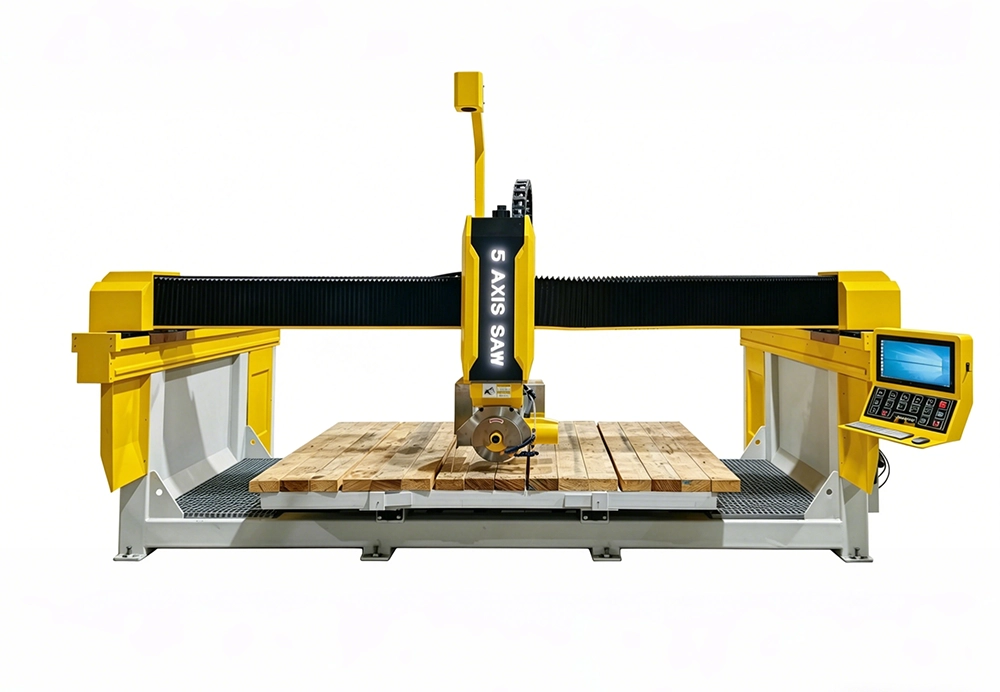
Une scie à pont 5 axes offre une plus grande flexibilité, notamment pour le traitement de différents types de pierre et les conceptions personnalisées
Exemple réel de fabrication
Une entreprise de fabrication de pierre produisant des plans de travail en quartz, des îlots en granit et des vasques en marbre utilisait auparavant des programmes de découpe distincts pour chaque matériau
Une scie à pont 5 axes offre une plus grande flexibilité, notamment pour le traitement de différents types de pierre et les conceptions sur mesure
Avant
Temps de configuration long
Résultat
Meilleure constance
Résultat
Gestion plus simple
Résultat
Production plus élevée
La capacité de passer rapidement entre les projets en quartz, granit et marbre a amélioré l’efficacité globale de la production
Pourquoi de plus en plus d’ateliers choisissent les scies à pont CNC multi-axes
Les entreprises de fabrication modernes ont besoin de flexibilité
Les clients demandent de plus en plus :
Les scies à pont traditionnelles nécessitent souvent plusieurs opérations secondaires
Une scie à pont CNC moderne combine :
en un seul flux de travail automatisé
Conclusion
Le quartz, le granit et le marbre présentent chacun des défis d’usinage uniques. Le quartz provoque la plus forte usure des outils, le granit exige une rigidité maximale de la machine et le marbre nécessite une qualité de finition exceptionnelle.
Comprendre ces différences permet aux ateliers de fabrication d’améliorer la productivité, de réduire les coûts d’exploitation et de livrer des produits finis de meilleure qualité
Que vous traitiez des plans de travail de cuisine en quartz reconstitué, des dalles de granit naturel ou des projets de marbre haut de gamme, le choix de la bonne scie à pont CNC et l’optimisation des paramètres de coupe sont essentiels à la réussite à long terme. Les scies à pont CNC 4+1 axes et 5 axes de Midecnc sont conçues pour aider les fabricants de pierre à traiter tous les principaux matériaux avec précision, efficacité et fiabilité.
Questions fréquemment posées
Dans de nombreux environnements de fabrication, oui. Le quartz est très abrasif et peut réduire la durée de vie des lames si les paramètres de coupe ne sont pas optimisés.
Le marbre est généralement plus facile à couper que le quartz ou le granit, bien qu’il nécessite une plus grande attention à la qualité de surface.
Oui. Les scies à pont CNC modernes peuvent couper efficacement le quartz, le granit et le marbre lorsqu’elles sont équipées des outils appropriés et de programmes spécifiques aux matériaux.
Pour les ateliers produisant des plans de travail sur mesure, des bords en onglet et des produits en pierre complexes, une machine 5 axes peut améliorer considérablement l’efficacité et la flexibilité.