Why Precise CNC Cutting Reduces Countertop Installation Problems
By combining digital templating, CAD/CAM programming, and high-precision CNC bridge saw technology, stone fabricators can consistently deliver countertops that fit correctly. Fewer installation delays, lower material waste, improved productivity.
Positioning Accuracy
First-Time Fit Rate
Cost Savings
Introduction
Countertop installation is the final stage of a stone fabrication project, but many installation failures originate much earlier—during the cutting process. Even minor dimensional deviations can result in poor seam alignment, uneven overhangs, incorrect sink openings, or costly on-site modifications.
As engineered stone, quartz, porcelain slabs, and natural stone become larger, thinner, and more complex, installation tolerances continue to shrink. Fabricators increasingly rely on CNC stone cutting technology to ensure every component fits exactly as designed.
This article explains how high-precision CNC cutting directly minimizes installation problems, improves fabrication consistency, and reduces project costs.
Installation Quality Improvement
Precise digital templating and CNC programming ensure every component fits perfectly, reducing on-site adjustments and modifications.
Production Efficiency Boost
From reduced material waste to lower rework rates, precision machining directly improves the bottom line.
Why Installation Accuracy Matters
Modern kitchens and commercial projects require countertops that integrate seamlessly with cabinets, sinks, cooktops, backsplashes, and decorative edge profiles.
Installation teams expect fabricated parts to arrive ready for assembly with minimal adjustment. Any dimensional error increases installation time and introduces unnecessary risk.
Common Installation Problems
Key Finding
Most of these issues originate from insufficient cutting precision rather than installation workmanship. This means problems can be solved at the source—the fabrication shop—by investing in precision CNC technology.
Precision machining not only improves aesthetics, but more importantly reduces customer dissatisfaction and rework costs.
The Relationship Between CNC Accuracy and Fit
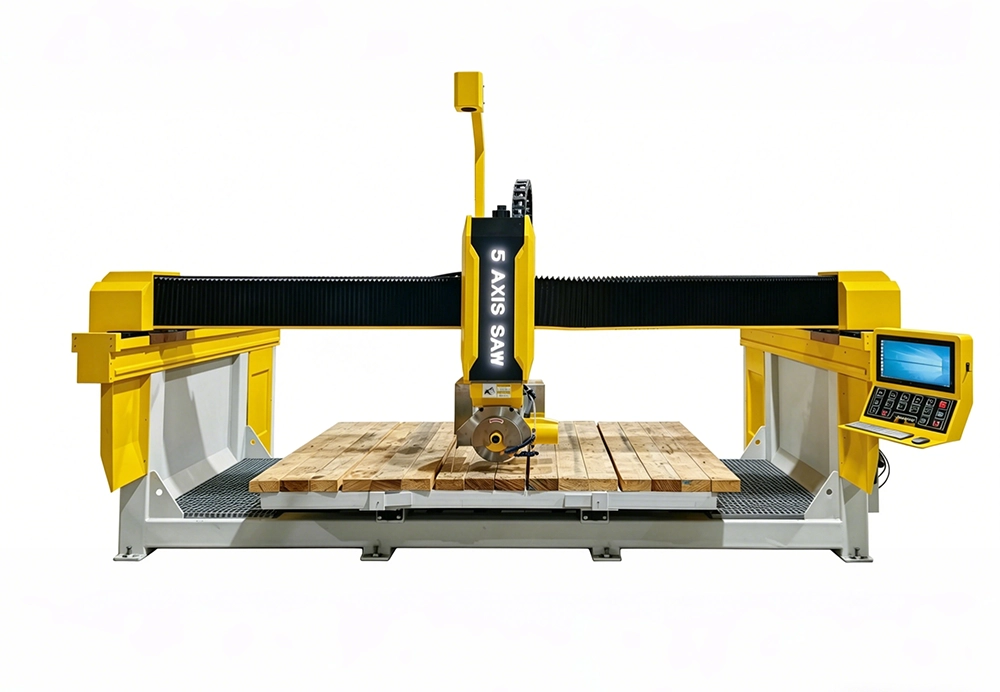
A CNC bridge saw follows programmed toolpaths using servo-controlled multi-axis motion. Unlike manual cutting, every movement is digitally controlled according to CAD or CAM data.
This Enables
Accuracy of High-Quality CNC Bridge Saws
Positioning Accuracy
±0.05 mm
Ensures exact dimensional reproduction
Repeatability
±0.02 mm
Consistency across batch production
The Result
A countertop that fits correctly on the first installation instead of requiring field adjustments. This consistency is a game-changer, especially for commercial projects requiring dozens or even hundreds of identical parts.
High-precision CNC machining ensures every workpiece matches the original digital design. No more "close enough"—the standard now is an exact match.
Accurate Sink and Cooktop Cutouts
Sink openings represent one of the most demanding machining operations. The opening must satisfy several requirements simultaneously.
Requirements the Opening Must Satisfy
Consequences of Precision Issues
Even a deviation of 1–2 mm may prevent an undermount sink from aligning properly. This may seem like a small issue, but it can lead to installation failure, rework, or worst case—customer dissatisfaction.
How CNC Solves This Problem
A CNC machine maintains constant tool movement throughout the contour, producing:
This reduces installation adjustments while improving the finished appearance. Clients receive a crafted product that looks like professional-grade work.
Better Seam Alignment
Large kitchen islands often require multiple slabs joined with precision seams. Poor seam quality can result from several factors.
Causes of Poor Seam Quality
Precise CNC Machining Ensures
Key Advantage
Well-machined seams require less adhesive compensation and create nearly invisible joints after installation. This is not only aesthetically superior but also practically more durable, as the seams are tighter.
In luxury residential projects, invisible seams are a mark of quality and craftsmanship. Precision CNC machining makes this an achievable standard, not an exception.
Eliminating Uneven Overhangs
Countertop overhang dimensions influence both aesthetics and structural safety.
The Problem with Manual Measurements
Manual measurements frequently produce inconsistent front projections throughout a kitchen. Some areas might be 1.25 inches, others 1.5 inches or more. This inconsistency is immediately noticeable to the eye, undermining a carefully designed look.
How CNC Cutting Ensures Consistency
CNC cutting maintains programmed offsets across every edge, ensuring:
✓ Uniform Front Overhang
The same dimension is maintained front to back across the entire countertop
✓ Consistent Island Dimensions
All four sides have the same overhang
✓ Symmetrical Layouts
Visually balanced symmetrical design
✓ Improved Visual Balance
A refined, carefully designed appearance
In luxury residential projects, this consistency becomes especially important. Clients notice details, and uneven countertop overhangs undermine the perceived quality of the entire space.
Wall Fitting Accuracy
Few walls are perfectly straight.
Modern fabrication begins with digital templating, where laser measurement systems capture the exact room geometry. The template is imported directly into CNC software, allowing the machine to reproduce irregular wall contours precisely.
Advantages of Digital Workflows
Digital workflows eliminate many errors introduced by manual template transfer. Laser precision + CNC automation = perfect fit.
When the installation team arrives on-site, the countertop is already ready. No surprises, no mismatches, no on-site adjustments.
Consistent Edge Profile Quality
Decorative edge profiles require extremely stable tool movement. Any vibration or feed inconsistency can produce defects.
Problems Caused by Unstable Tool Movement
CNC-Controlled Interpolation Ensures
Every profile follows the same programmed path. Whether producing eased edges, bullnose profiles, beveled edges, or laminated designs, precision machining improves both appearance and dimensional consistency.
A precision-machined edge profile is both beautiful and consistent. Clients immediately notice the difference, associating it with high-end craftsmanship.
Reduced Material Chipping
Large-format porcelain and sintered stone are considerably more brittle than traditional granite. Improper cutting parameters frequently cause edge breakout.
Material Brittleness Challenge
Porcelain and sintered stone do not absorb cutting stress like natural stone. A slight deviation in one cutting parameter can cause catastrophic edge breakout.
Problems Caused by Incorrect Cutting Parameters
Modern CNC Bridge Saws Optimize
Combined with rigid machine construction, these controls significantly reduce edge chipping and improve installation quality. Now porcelain and even sintered stone components can be machined as precisely as granite—or better.
Repeatability Across Multiple Countertops
Commercial projects often require dozens or even hundreds of identical countertops.
Manual fabrication makes maintaining identical dimensions across every unit extremely difficult. Fabricator fatigue, tool wear, material variation—all these factors contribute to variation between batches.
Project Examples Requiring Repeatable Precision
CNC Machining Guarantees Repeatable Production
Ensuring that each countertop matches the approved design regardless of production batch. This consistency simplifies logistics, installation scheduling, and quality inspection.
Simplified Logistics
All parts are identical, making tracking and transport easy
Faster Installation
Installation teams know what they're getting—no surprises
Quality Auditing
Consistent production makes quality inspection straightforward
For large fabrication shops processing hundreds of identical residential or commercial projects, this repeatable precision is a game-changer.
Reduced On-Site Labor
Every on-site modification increases project cost.
On-Site Modifications Installers May Need to Perform
Problems with On-Site Modifications
Consumes Labor: These operations consume significant installation time, increasing the risk of project delays.
Increases Risk: Each modification increases the chance of damaging a finished product—an expensive mistake.
Benefits of Precision CNC Fabrication
Accurate CNC fabrication minimizes field corrections, allowing installers to complete projects faster with fewer unexpected complications.
This benefits both installation teams and fabrication shops. Installers work faster and face fewer problems. Fabrication shops earn a better reputation and higher satisfaction scores.
Lower Total Project Costs
Although precision CNC equipment requires greater initial investment, it substantially lowers total production costs over time.
Savings Come From
Return on Investment
For fabrication shops processing large volumes of countertops, these operational efficiencies often generate a rapid return on investment. Precision CNC equipment pays for itself within 1–2 years.
Direct Cost Savings
- • Less wasted material
- • Reduced rework
- • Lower labor costs
- • Transport integrity
Indirect Benefits
- • Better customer satisfaction
- • Fewer warranty claims
- • Improved brand reputation
- • Increased repeat business
For fabricators seeking to improve production efficiency while reducing costly installation issues, precision CNC cutting is no longer simply a manufacturing upgrade—it has become a fundamental requirement for modern countertop fabrication.
Features That Improve Cutting Precision
Several machine characteristics in precision CNC bridge saws contribute directly to fabrication accuracy.
How These Features Work Together
Machine rigidity prevents vibration. Servo systems control motion. Guide rails maintain consistency. Automatic calibration compensates for wear. Vacuum secures the material. CAD/CAM eliminates human error.
The result: repeatable, precise, reliable production—batch after batch.
Industries Benefiting Most
Precise CNC countertop fabrication is widely adopted across:
Key Insight
As projects become increasingly customized, digital precision has become essential for maintaining installation quality. Whether fabricating countertops for a single luxury home or hundreds of hotel rooms, precision CNC cutting ensures every component fits perfectly.
Customization Drives the Need for Precision
Modern construction no longer accepts "one size fits all." Each project has unique requirements, layouts, and specifications. Precision CNC machining enables fabricators to produce these custom components while maintaining strict tolerances and fast turnaround times.
Conclusion
Countertop installation quality begins long before the installation crew arrives on-site. Every accurate measurement, every precise toolpath, and every controlled cutting movement contributes to a smoother installation process.
With Precision CNC Cutting, Every Element Matters
The Final Result
By combining digital templating, CAD/CAM programming, and high-precision CNC bridge saw technology, stone fabricators can consistently deliver countertops that fit correctly the first time. The result is fewer installation delays, lower material waste, improved productivity, and a higher standard of finished workmanship.
For fabricators seeking to improve production efficiency while reducing costly installation issues, precision CNC cutting is no longer simply a manufacturing upgrade—it has become a fundamental requirement for modern countertop fabrication.
Installation Time Reduction
Rework Rate Reduction
ROI Period
Ready to Transform Your Fabrication Efficiency?
Investing now means less material waste, fewer reworks, and increased customer satisfaction. Precision CNC cutting is no longer a competitive advantage—it's a fundamental requirement for modern countertop fabrication.
Systems Installed Worldwide
Years of Industry Experience
Customer Satisfaction Score