Complete Guide to CNC Bridge Saws for Stone Fabrication

In modern stone fabrication, precision and efficiency are not optional — they define profitability. Whether a workshop is cutting granite slabs for kitchen countertops or producing complex marble components for commercial buildings, the choice of cutting equipment directly impacts quality, output, and cost control.
This complete guide to CNC bridge saws for stone fabrication is designed for stone factory owners, production managers, and project decision-makers. It explains what CNC bridge saws are, how they work, the different axis configurations, where they are used, and how to choose the right machine for real production needs — not just specifications on paper.
CNCブリッジソーとは?
A CNC bridge saw is a computer-controlled stone cutting machine specifically designed to process hard materials such as granite, marble, quartz, and engineered stone. CNC (Computer Numerical Control) means the cutting process is driven by programmed instructions rather than manual operation — eliminating human error and ensuring consistent results.
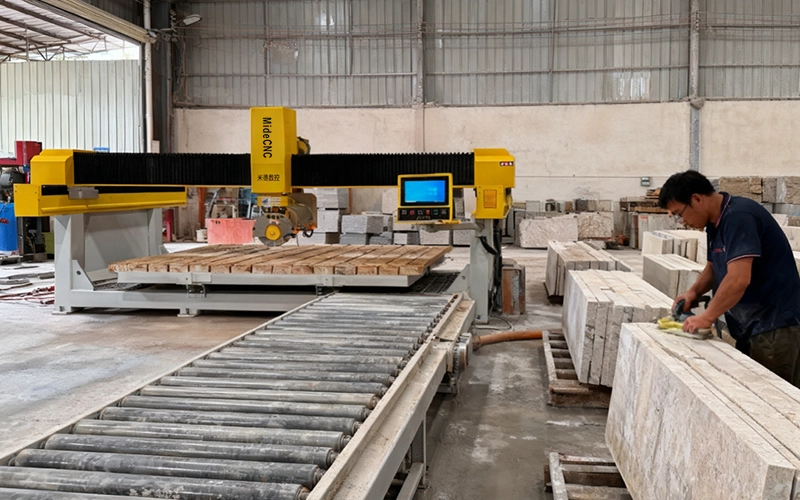
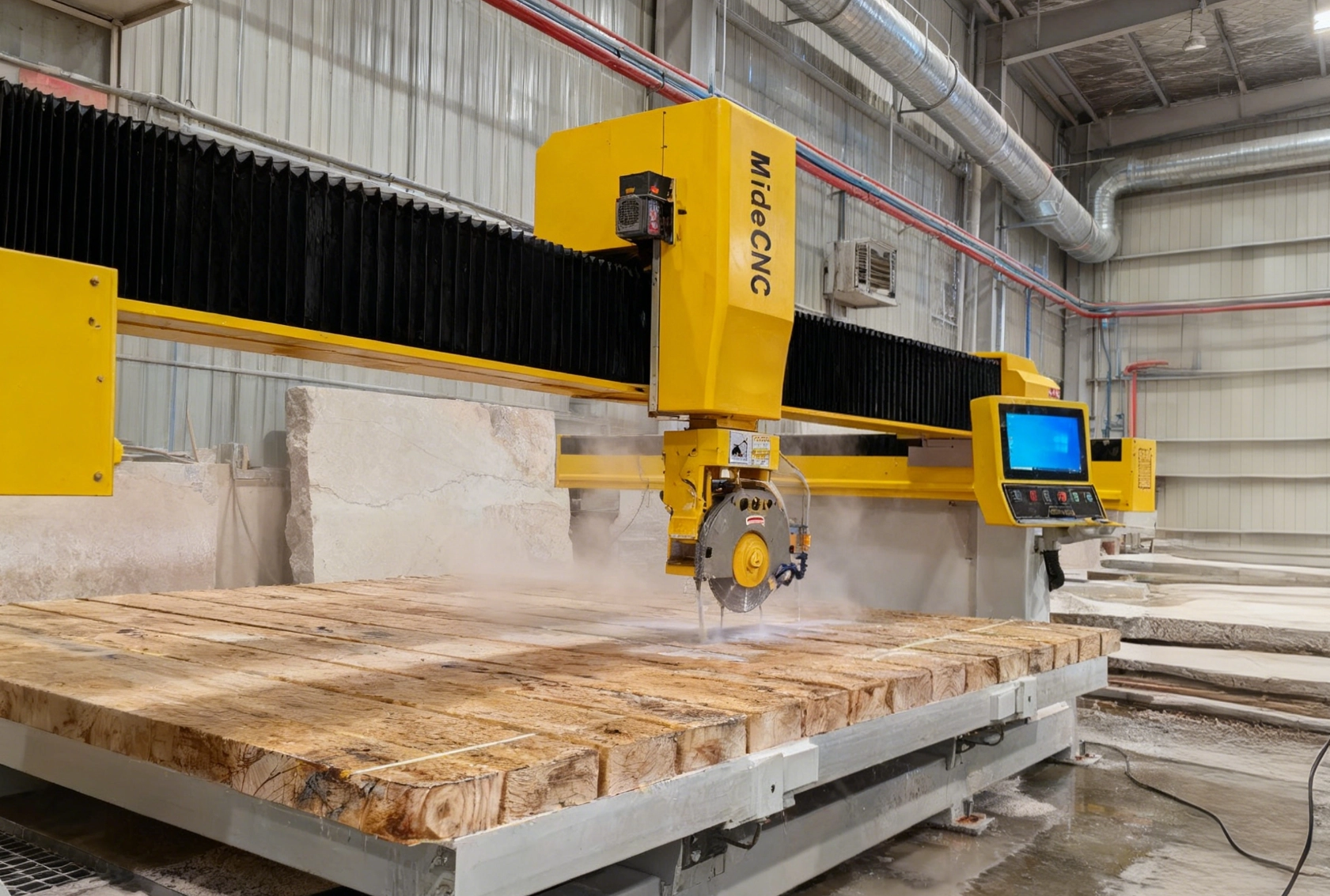
The term "bridge saw" comes from its rigid bridge-style structure, which spans the cutting table. The cutting head travels precisely along this bridge, ensuring stable movement, high accuracy, and consistent cutting results — even on large or heavy stone slabs (up to 3000×1600mm).
In stone fabrication, CNC bridge saws are the backbone of modern workshops because they combine cutting accuracy, automation, and production efficiency in a single machine. According to the Stone Fabrication Industry Report 2024, CNC bridge saw adoption has increased by 45% in the past 3 years due to rising labor costs and demand for higher precision.

How CNC Bridge Saws Work
At the core of every CNC bridge saw is a high-speed diamond blade (diameter 300-600mm) capable of cutting dense stone materials with minimal chipping. The cutting head typically moves along three primary axes:
- X-axis: left to right (travel range up to 3200mm)
- Y-axis: forward and backward (travel range up to 1800mm)
- Z-axis: up and down (cutting depth up to 200mm)
More advanced configurations, such as 4+1 axis and 5 axis CNC bridge saws, add rotational (A-axis) and tilting (C-axis) movements. These additional axes allow the blade to cut bevels, miters, curves, and complex 3D shapes in a single setup — a critical advantage for architectural and custom stone work.
A typical CNC bridge saw workflow includes:
- Importing CAD/CAM drawings or programming cutting paths directly at the control panel (compatible with AutoCAD, SolidWorks)
- Securing the stone slab on the vacuum worktable to prevent movement during cutting
- Automatically executing cutting operations according to the programmed parameters (speed: 0-60m/min)
- Using water cooling systems (flow rate: 50L/min) to reduce blade temperature, suppress dust, and improve surface finish
This automated process dramatically improves cutting consistency while reducing reliance on skilled manual labor — a single operator can manage 2-3 machines simultaneously.
Who Should Use CNC Bridge Saws?
CNC bridge saws are not limited to one type of stone business. They are widely used across multiple segments of the stone industry:
- Stone fabrication factories producing slabs, tiles, and customized components (granite, marble, quartz)
- Kitchen countertop workshops requiring sink cut-outs, edge profiling, and angled joints
- Commercial construction projects such as hotels, shopping malls, and office buildings
- Architectural stone suppliers creating curved, chamfered, or complex decorative elements
Any operation that values precision, repeatability, and scalable production will benefit from CNC bridge saw technology. Our clients include top 10 stone fabrication factories in Europe and North America using Midecnc machines.

Key Benefits of CNC Bridge Saws in Stone Fabrication
Consistent Cutting Precision
CNC control ensures that every cut follows the exact programmed path (precision ±0.1mm for 5-axis models). This level of repeatability is essential for projects with tight tolerances or standardized production requirements — reducing rework from 8% to less than 1%.
Higher Production Efficiency
Automated cutting paths reduce idle time and shorten production cycles by 30-50% compared with manual sawing, allowing factories to handle higher order volumes without increasing labor costs.
材料の無駄削減
Accurate positioning and optimized nesting software help minimize offcuts by 15-20% — a major cost savings when working with expensive stone materials (granite costs $50-$150 per square foot).
Greater Processing Flexibility
Advanced axis configurations allow a single CNC bridge saw to perform straight cuts, bevels (0-90°), miters, edge shaping, and complex 3D contours without multiple machines — reducing capital expenditure by 40%.
Types of CNC Bridge Saws Explained
Understanding axis configurations is critical when selecting the right CNC bridge saw. Below is a detailed comparison of the most common configurations:
| 特徴(とくちょう)/ 機能(きのう) | 3-Axis | 4+1 Axis | 5 Axis |
|---|---|---|---|
| Cutting Precision | ±0.5mm | ±0.2mm | ±0.1mm |
| Max Bevel Angle | 0° | 45° | 90° |
| Typical ROI | 12-18 months | 10-15 months | 8-12 months |
| Price Range (USD) | $7,000-$10,000 | $15,000-$25,000 | $30,000-$50,000 |
| に最適 | Basic slab cutting | Countertops, architectural work | Complex 3D components |
3-Axis CNC Bridge Saw
A standard 3-axis machine handles straight cuts and basic profiling efficiently. It is suitable for small workshops with simple slab cutting needs (e.g., tile production) and limited budget.
4+1軸CNCブリッジソー
The 4+1 axis configuration adds a rotating (A-axis) or tilting function, enabling angled cuts and advanced edge processing. For many stone factories, this represents the ideal balance between versatility, productivity, and investment cost — especially for countertop and architectural applications (our best-selling model at Midecnc).
5軸CNCブリッジソー
A 5 axis CNC bridge saw provides full multi-directional movement (X/Y/Z/A/C axes), allowing the blade to tilt and rotate freely. This configuration is essential for undercuts, curved profiles, and complex 3D stone components. For high-end fabrication and demanding projects, a 5 axis system often becomes indispensable rather than optional.

At Midecnc, both 4+1 axis and 5 axis CNC bridge saws are engineered to meet the real-world demands of stone fabrication — from heavy-duty production (8-hour continuous operation) to intricate custom work. All our machines come with 2-year warranty and lifetime technical support.
Key Features to Look for in a CNC Bridge Saw
When evaluating CNC bridge saws, focus on factors that directly affect long-term performance and total cost of ownership:
- Machine frame rigidity (welded steel structure) to reduce vibration and improve cutting stability
- Reliable CNC control systems (Siemens/FANUC) compatible with mainstream CAD/CAM software
- High-torque spindles (15-22kW) and quality diamond blades for efficient stone cutting
- Effective water and dust management systems (50L/min flow rate) to protect tools and operators
- Automation options (automatic tool changers, vacuum tables) for higher throughput
- Energy efficiency (380V/50Hz, 15-30kW power consumption) to reduce operational costs
These elements determine not only cutting quality but also machine lifespan (10-15 years for well-maintained machines) and maintenance costs (typically 5-8% of purchase price per year).
Cost vs Value: Understanding the Real ROI
A CNC bridge saw is a significant investment, but its value should be measured beyond the initial purchase price. The true ROI comes from operational efficiencies and revenue growth.
Factories typically see returns through:
- Reduced labor dependency (1 operator for 2-3 machines vs 1 operator per manual saw)
- Faster production cycles (30-50% increase in output volume)
- Lower material waste (15-20% reduction in offcuts)
- Improved consistency and reduced rework (from 8% to <1%)
- Ability to take on high-value complex projects (premium pricing for custom work)
Case Study: A US-based stone fabrication shop purchased a Midecnc 4+1 axis CNC bridge saw for $21,000. They saw a 40% increase in monthly output, reduced labor costs by $3,000/month, and cut material waste by $1,500/month — achieving full ROI in just 12 months.
When evaluated over years of operation, the right CNC bridge saw often delivers a strong return on investment by improving overall production efficiency and competitiveness.
How to Choose the Right CNC Bridge Saw for Your Workshop
Selecting the right machine starts with understanding your production requirements and long-term business goals:
- What stone materials (granite/marble/quartz) and thicknesses (10-100mm) do you process most often?
- Do your projects require angled, curved, or complex 3D shapes (or just straight cuts)?
- What output volume (sq. ft./month) and level of automation do you need?
- What is your budget (initial investment + ongoing maintenance)?
- Do you need CE/ISO certification for export projects?
For workshops seeking flexibility without excessive cost, a 4+1 axis CNC bridge saw is often the most practical solution. For factories handling complex architectural elements or premium projects (e.g., luxury hotel interiors), a 5 axis CNC bridge saw provides unmatched processing capability.
Installation, Training, and Long-Term Support
A CNC bridge saw is only as effective as the team operating it. Professional installation, operator training, and ongoing technical support are essential to ensure consistent performance and long-term reliability.
Midecnc supports customers throughout the entire lifecycle of their CNC stone cutting machines:
- Professional on-site installation (2-3 days) by certified technicians
- Operator training (40 hours) for basic and advanced operations
- 24/7 technical support via phone/email/remote access
- Spare parts availability (95% parts in stock for next-day delivery)
- Preventive maintenance programs to extend machine lifespan
よくある質問 (FAQ)
結論
CNC bridge saws have become indispensable in modern stone fabrication. They combine precision, efficiency, and versatility, enabling stone workshops to meet rising quality demands while controlling production costs.
By understanding how CNC bridge saws work, how different axis configurations impact production, and what features truly matter, stone fabricators can make informed decisions that strengthen their competitive edge.
For workshops and factories seeking reliable, high-performance CNC solutions, Midecnc’s 4+1 axis and 5 axis CNC bridge saws provide the cutting accuracy and production efficiency required in today’s stone fabrication industry.
Need a Custom CNC Bridge Saw Solution?
Our experts will assess your production needs (free of charge) and recommend the right machine for your workshop, budget, and long-term goals.
Contact Our Team →推奨機械
インテリア装飾の専門家に向けて、Midecnc は高精度・高効率・創造的な柔軟性を兼ね備えた CNC マシンを提供しています。焼結石、セラミックパネル、複合材料などを扱う際にも、当社のブリッジソーと彫刻システムは、芸術的なディテール加工と構造的な製造の両方に最適化されています。
5軸CNCブリッジソー
高級なインテリアおよび建築用途向けに設計された5軸CNCブリッジソーは、超高精度の留め切り、曲線成形、シンク開口、さらには浮き彫り加工まで、すべてをインテリジェントなワークフローで実現します。焼結石、大理石、クォーツ、セラミックパネルに対応し、設計者と加工業者に卓越した効率性と多様性を提供します。
- Photo Taking & Suction Cup System: Advanced alignment and stone stabilization system enhances safety and accuracy.
- 真の5軸切断:XYZ全方向の動きに加え、スピンドルの回転と傾斜により、高度な3D加工、エッジ成形、最大45°の斜め切断が可能です。
- 複雑な形状に対応:三角形、楕円形、ひし形、円形、カウンタートップ、テーブルなどの切断に最適です。
4+1軸CNCブリッジソー
留め切り、直線研磨、埋め込みスロット加工が必要なプロジェクトに最適な選択です。信頼性が高く、高速で、日常の室内切断作業に使いやすい設計です。
- ±90°のブレード回転、0~90°の傾斜対応
- キャビネット溝加工や照明スロット作成に最適
- Heavy-duty frame & easy control: Built for stability and intuitive operation
AC 5軸CNCウォータージェット切断機(4020AC)
大判スラブの切断、縁取り加工、留め加工に最適なフラッグシップモデル。磁器、焼結石、装飾材を使用した室内用途に理想的です。
- 5軸フルインターポレーション切削により、継ぎ目のない接合と芸術的な角度加工を実現
- 自動ネスティングとインテリジェントなツールパス最適化により、材料ロスを削減
- 磁器、岩板、ガラス、MDF、複合素材に対応