CNC Stone Fabrication Solutions
The Perfect Fusion of Bridge Saws and Waterjets
How modern stone factories combine two precision cutting technologies to improve efficiency, reduce waste, and achieve an optimized production process.
Chapter 1
CNC Bridge Saws and Waterjets Solve Different Cutting Problems
A CNC bridge saw and a CNC waterjet machine are both precision cutting systems, but their mechanical cutting principles are fundamentally different.
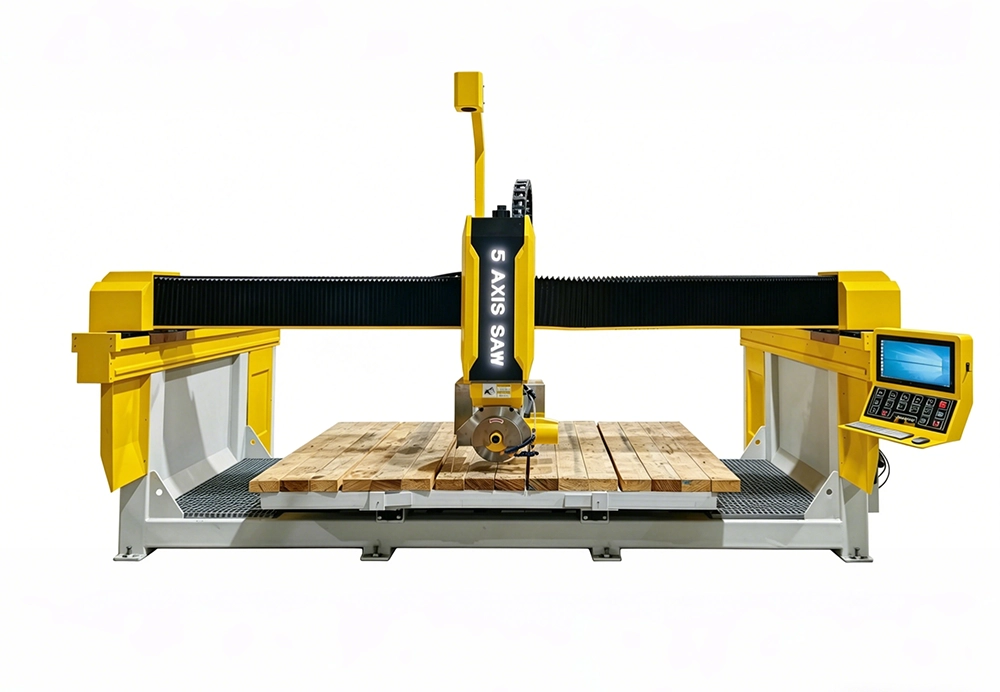
Cưa cầu CNC
Uses a diamond blade to remove material through mechanical cutting. Particularly effective for:
- Straight cuts and cross cuts
- Mitre cuts and rectangular components
- High-volume slab processing
- Repetitive production and standard countertops
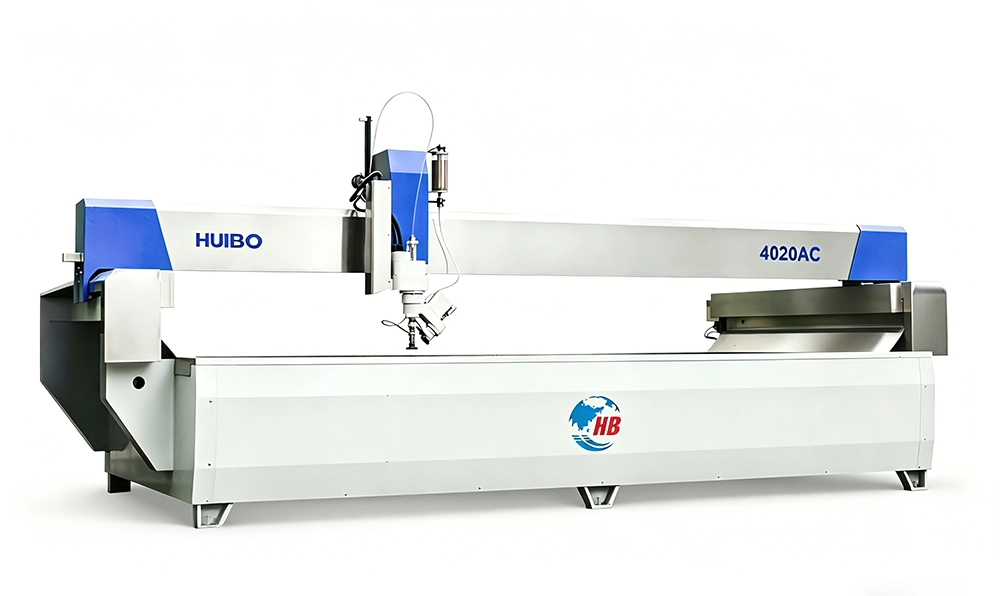
CNC Waterjet
Uses a high-pressure abrasive water stream to erode material along a programmed toolpath. Better suited to:
- Curved profiles and irregular shapes
- Internal cutouts and sink openings
- Complex geometric patterns
- Inlays, decorative work, and intricate architectural components
Key insight:The difference becomes important when a factory processes a wide variety of orders. Using a bridge saw for every operation may require additional manual cutting, grinding, or profiling. Using a waterjet for every cut, meanwhile, can be inefficient when most of the work consists of simple straight cuts. A combined production line allows the factory to use the fastest suitable process for each operation.
Chapter 2
Straight Cuts Stay with the CNC Bridge Saw
For most stone fabrication operations, a significant percentage of cutting consists of simple linear geometry.
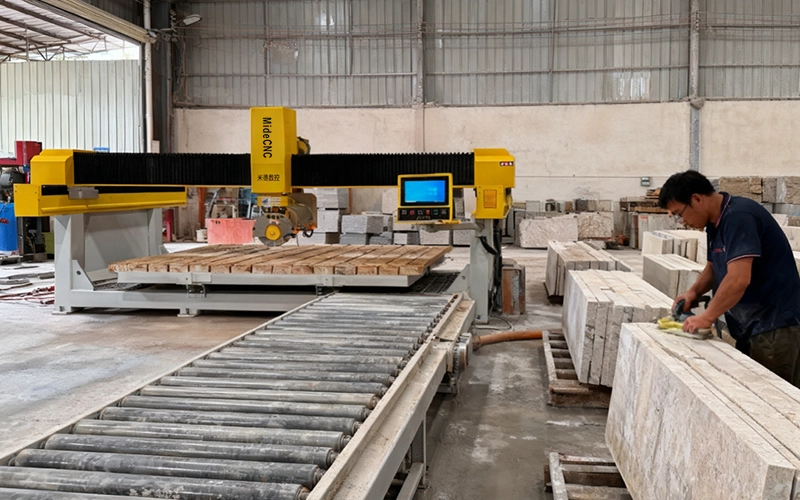
Typical Production Sequence
Slab
Raw slab for cutting
Cưa cầu CNC
Dimensional cutting and primary linear operations
Waterjet
Complex contours and internal openings
Edge Processing
Polishing and final finishing
This is particularly valuable for manufacturers producing multiple countertops, vanity tops, stair components, and other repetitive stone products. Modern CNC bridge saws use servo-driven axes, digital positioning, automatic tool setting, and CNC interpolation to control blade movement accurately. Depending on the machine configuration, the saw head can also perform automatic rotation and mitre cutting.
Chapter 3
Waterjet Technology Handles Complex Geometry
The major advantage of waterjet cutting appears when the geometry becomes difficult. Diamond blades are inherently suited to linear cutting. Although multi-axis CNC bridge saws can produce angled and certain curved cuts, complex internal contours and small-radius geometries can require multiple operations.
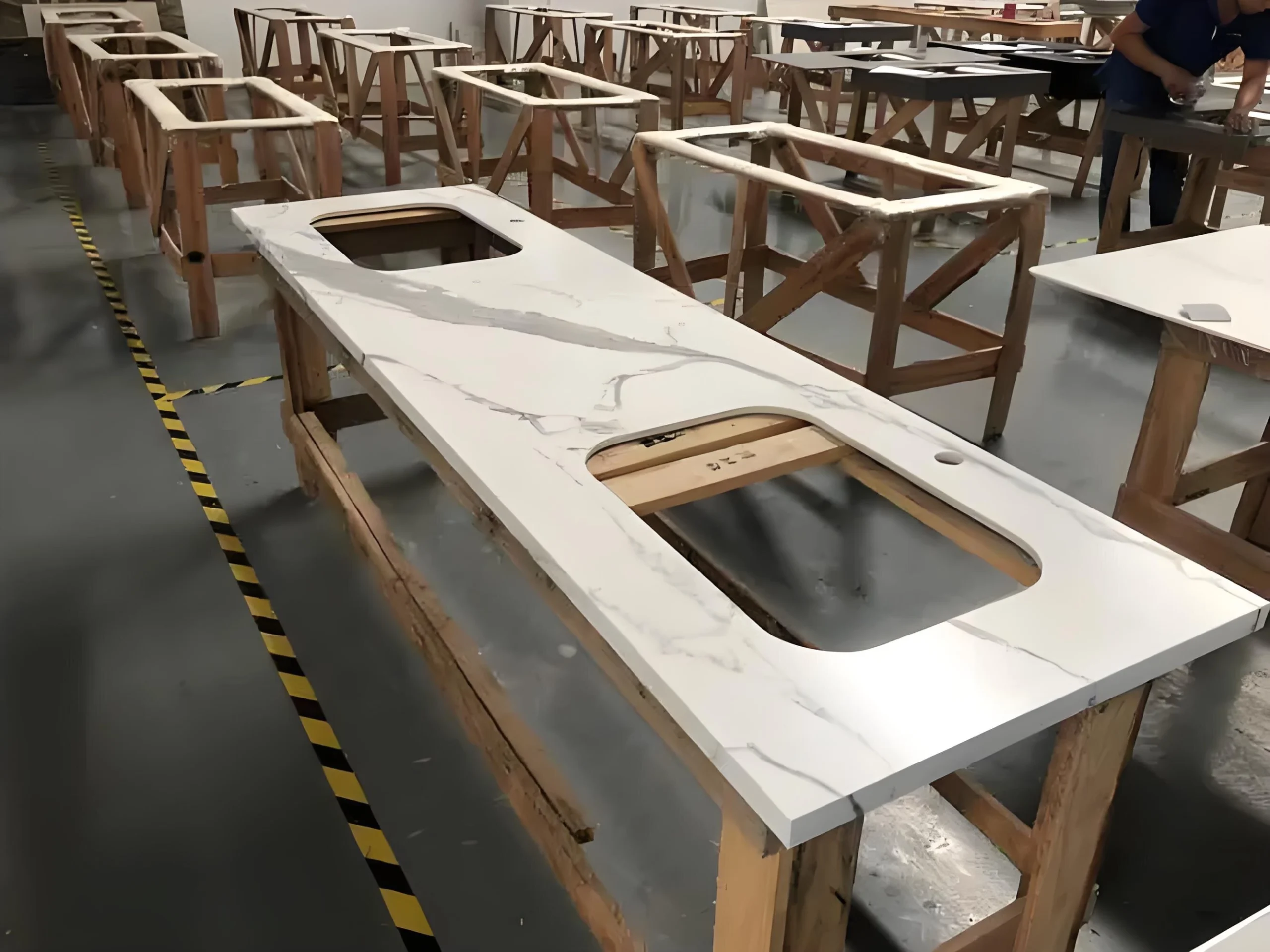
Cắt lỗ chậu rửa
Undermount and flush-mount sink openings often require accurate internal profiles and controlled corner radii.
Cooktop Openings
Induction cooktops and other built-in appliances frequently require precise rectangular or custom-shaped openings.
Curved Countertops
Curved islands, radius countertops, reception desks, and architectural surfaces can be programmed directly from CAD geometry.
Decorative Inlays
Waterjet machines can cut marble, granite, quartz, porcelain, and other materials into detailed patterns for flooring, walls, furniture, and architectural decoration.
Chapter 4
The Combination Reduces Secondary Processing
One of the hidden costs in stone fabrication is not always the cutting operation itself. It is the work that comes afterward.
Typical Secondary Operations
- Grinding and trimming
- Radius correction
- Internal corner finishing
- Manual shaping
- Template adjustment
- Edge correction
Each secondary operation adds labor and introduces another opportunity for dimensional deviation. With a CNC bridge saw handling the primary dimensional cuts and a waterjet producing complex profiles, more of the geometry can be completed directly from the digital cutting program. This reduces dependence on manual correction.
The result:Not only faster production, but also a more consistent process from one workpiece to the next. For factories producing multiple identical countertops or architectural components, repeatability is particularly important.
Chapter 5
Better Material Utilization Through Digital Nesting
Material utilization has a direct impact on stone fabrication profitability. A slab may contain significant material value, particularly when processing premium marble, quartzite, granite, porcelain, or large-format sintered surfaces.
Digital Nesting Considerations
Straight components can then be processed efficiently with the bridge saw, while irregular profiles and internal geometries are transferred to the waterjet process. This allows manufacturers to make better use of the available slab area rather than designing every component around the limitations of a saw blade. For high-value stone, even a small improvement in slab utilization can have a meaningful effect on production cost.
Chapter 6
One Slab Can Contain Multiple Production Requirements
Another advantage of combining the two technologies is the ability to process different types of components from the same slab.
Kitchen Countertop Project Example
One slab may need to produce the following components:
The CNC bridge saw can handle the main linear cuts and dimensional separation. The waterjet can then process the complex internal openings and curved geometries. This production strategy allows the factory to treat the slab as one optimized production layout instead of dividing the work into disconnected manual operations.
Chapters 7-8
Premium Stone and Porcelain
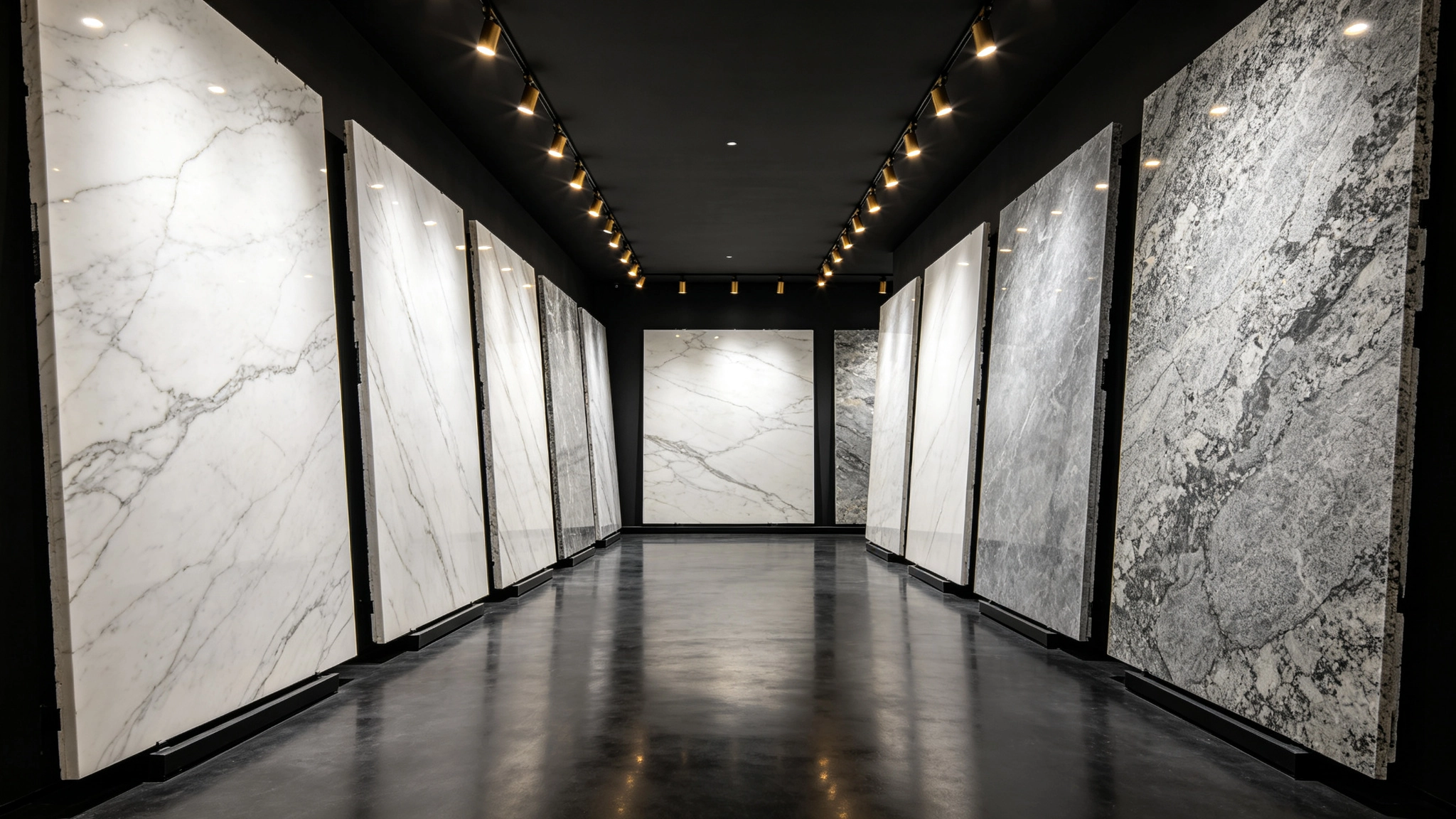
Premium natural stone requires more than simple cutting speed. Material cost, pattern continuity, edge quality, and breakage risk all become important considerations.
Natural Stone Processing
Quartzite, marble, granite, and other high-value slabs can contain natural veins, inclusions, fissures, and variations in density.
- Digital cutting allows fabricators to plan the component layout before machining begins
- For visually important projects, operators can also consider vein direction and pattern continuity during nesting
- The waterjet becomes especially useful for complex cutouts where the cutting path must follow a precise CAD profile
Porcelain and Sintered Stone
Large-format porcelain and sintered stone have introduced new cutting requirements to many fabrication shops.
- Straight cuts can be efficiently performed using suitable diamond tooling on a CNC bridge saw
- Complex internal cutouts, irregular shapes, and detailed profiles can be assigned to waterjet cutting
- A combined approach selects the cutting process according to the material and geometry involved
Chapter 9
Production Capacity Grows Without Making Every Machine Do Everything
A common mistake in production planning is trying to make one machine perform every operation. This can create a bottleneck.
Cưa cầu CNC
Best suited for:
- High volume
- Straight geometry
- Dimensional cutting
CNC Waterjet
Best suited for:
- Complex Geometry
- Internal cutouts
- Precision profiling
A combined system creates a more balanced production workflow. The result is a production line in which each machine performs the work for which it is most technically and economically appropriate.
Chapter 10
Digital CAD/CAM Integration Makes the Workflow More Efficient
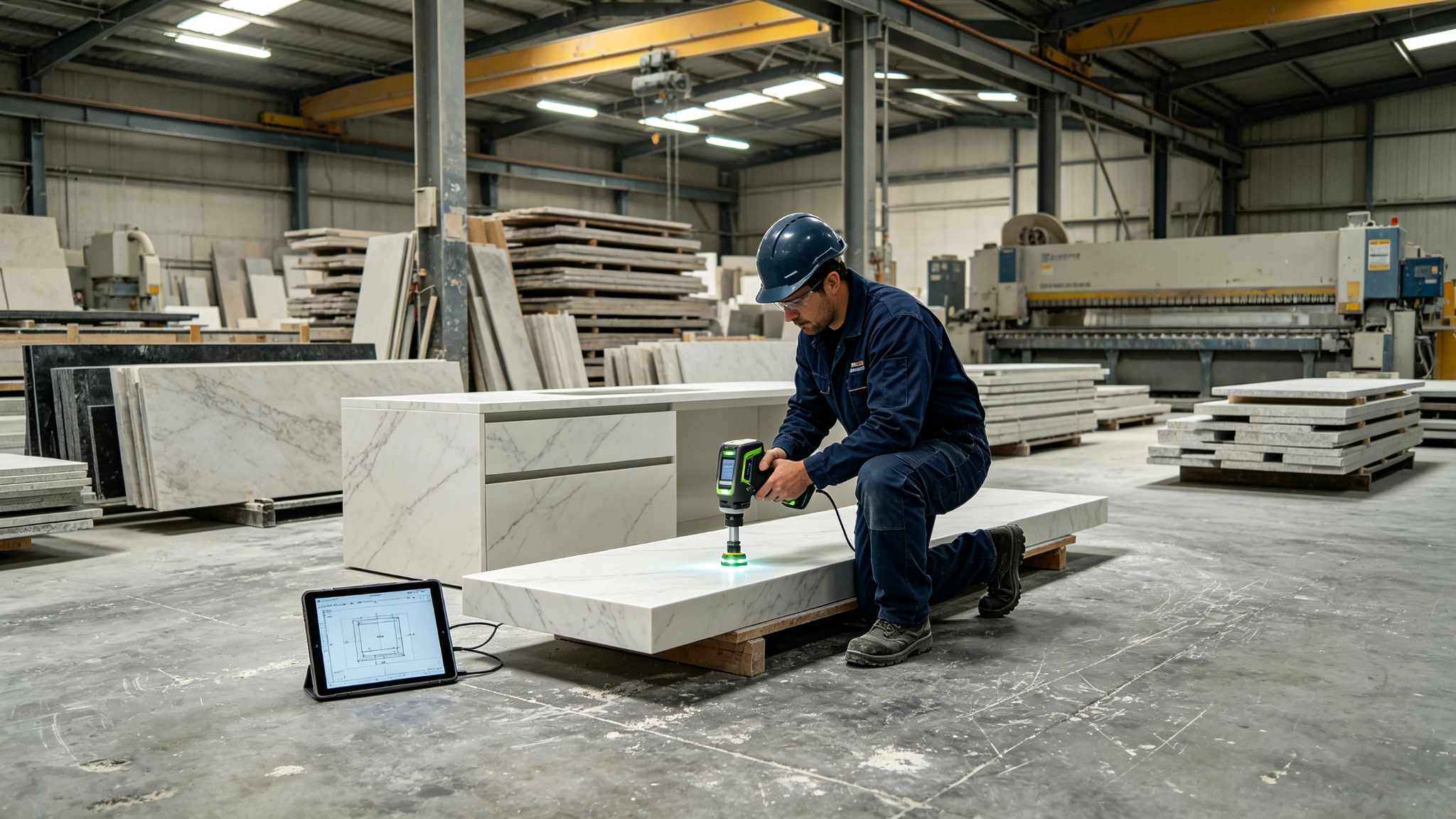
The real value of combining the two machines comes from software integration. Modern stone fabrication increasingly begins with digital drawings rather than manual templates.
Typical Production Data Sources
Simplified Workflow Structure
This reduces manual measurement and helps maintain consistency between design intent and finished components. When the bridge saw and waterjet are connected to a standardized digital workflow, operators can also reduce repeated data entry and minimize programming errors.
Chapter 11
Labor Requirements Become More Predictable
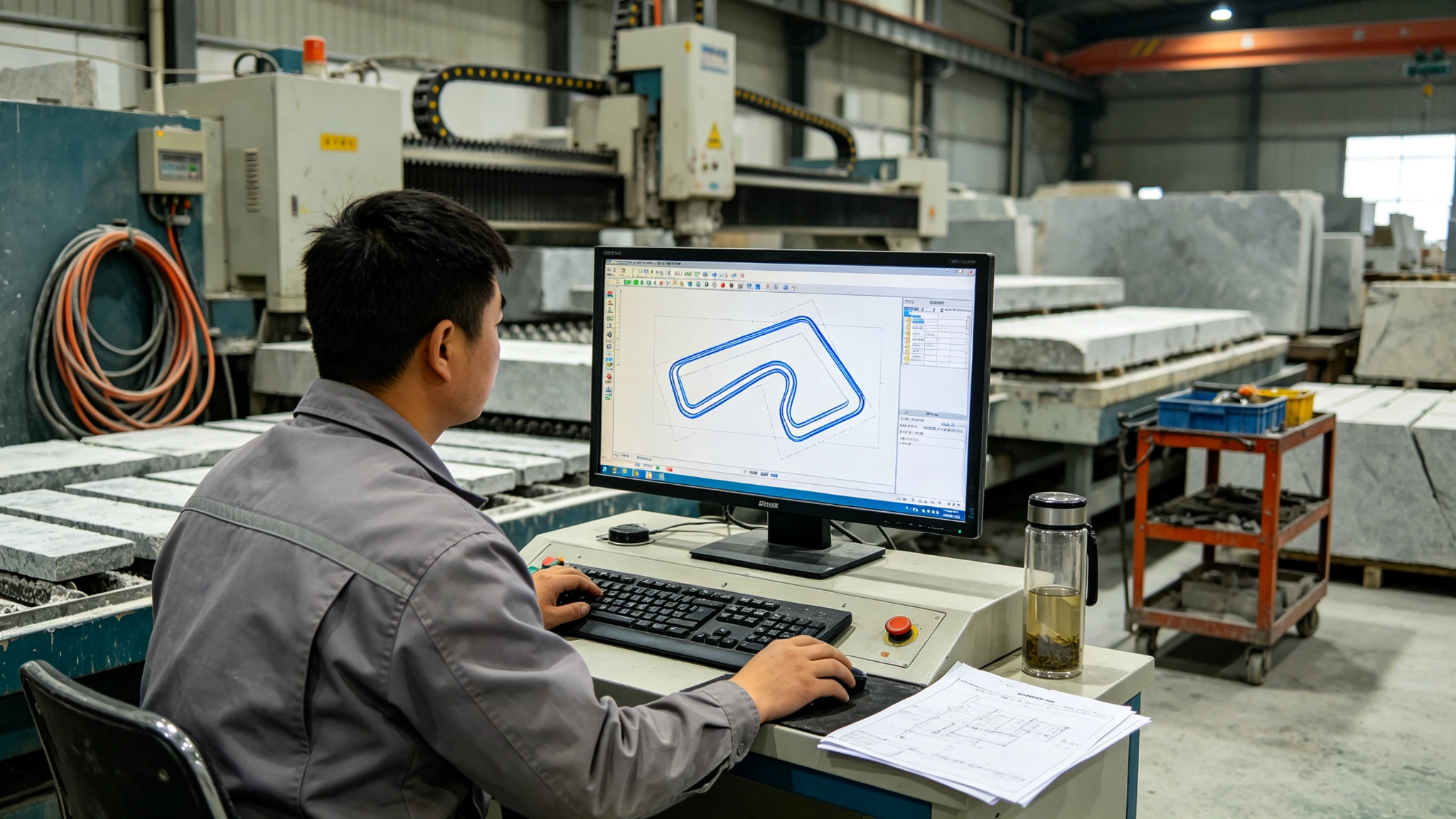
Labor availability is becoming an important consideration for stone manufacturers. Traditional stone fabrication can require experienced workers for measuring, marking, cutting, shaping, and correcting components.
How CNC Automation Shifts the Operator Focus
The machine handles repetitive positioning and programmed cutting operations. This creates a more standardized manufacturing process and reduces the amount of production that depends on individual manual cutting skills.
Chapter 12
The Investment Logic Is Based on Process Optimization
The decision to purchase both machines should not be based simply on machine specifications. The more important question is: how much production time and material value can the combined workflow recover?
Key Factors to Evaluate
Current Cutting Volume
How many slabs are processed per day or month?
Geometry Distribution
What percentage of production consists of straight cuts versus complex profiles?
Labor Cost
How much time is spent on manual cutting, grinding, correction, and template work?
Lãng phí vật liệu
How much usable stone is lost because of inefficient nesting?
Rework Rate
How frequently are components rejected or corrected because of dimensional errors?
Production Lead Time
How quickly must the factory complete custom orders?
Future Product Mix
Will the factory move toward more custom countertops, architectural projects, porcelain, or premium natural stone?
The answers determine whether a bridge saw, waterjet, or combined production system provides the strongest return.
Chapter 13
A Typical High-Efficiency Workflow
For a modern stone fabrication factory, the workflow can be organized around the strengths of each technology.
1. Digital Measurement
The countertop or architectural component is measured using a digital templating system.
2. CAD/CAM Preparation
The geometry is converted into production-ready CAD/CAM data.
3. Slab Layout and Nesting
Components are arranged according to slab dimensions, material defects, grain direction, and vein requirements.
4. CNC Bridge Saw Cutting
Straight cuts, mitres, and primary dimensional operations are completed first.
5. Waterjet Cutting
Complex contours, sink openings, cooktop openings, curved sections, and decorative profiles are processed.
6. Edge Processing
Components move to polishing, profiling, or edge-finishing equipment as required.
7. Quality Inspection
Dimensions, openings, edge conditions, and surface quality are checked before installation or shipment.
This approach creates a more controlled production sequence from slab to finished component.
Chapter 14
When Should a Stone Factory Consider Both Machines?
A combined CNC bridge saw and waterjet production system is particularly attractive when a factory has several of the following characteristics:
For a small workshop with mostly basic straight cuts, a CNC bridge saw may provide the better initial investment. For a factory producing highly customized stone components, however, adding a CNC waterjet can significantly expand the range of products that can be manufactured in-house.
Chapter 15
Bridge Saw + Waterjet Is Becoming a Production Strategy
The biggest change is not the machines themselves. It is the production philosophy behind them.
Process Specialization in Modern Stone Factories
Cưa cầu CNC
Fast dimensional cutting
Optimized for straight cuts, rectangular components, and high-volume production
CNC Waterjet
Complex profile cutting
For internal cutouts, curves, and precision profiles
CNC Edge Processing
Surface and edge finishing
For polishing, bullnosing, and decorative edges
CAD/CAM
Digital production control
Programming and optimization that control the entire workflow
Each stage has a defined role. This approach improves workflow organization, reduces unnecessary manual operations, and makes production capacity easier to scale. For manufacturers competing on delivery time, material efficiency, and dimensional consistency, this can be more valuable than simply purchasing a higher-powered cutting machine.
Technology Comparison
| Capability | Cưa cầu CNC | CNC Waterjet |
|---|---|---|
| Straight Cuts | ✓ Excellent | ○ Fair |
| Đường viền phức tạp | ○ Manual adjustment needed | ✓ Excellent |
| Internal cutouts | ✗ Difficult | ✓ Excellent |
| Curved cutting | ○ Limited | ✓ Excellent |
| High-volume production | ✓ Excellent | ○ Moderate |
| Decorative Inlays | ✗ Difficult | ✓ Excellent |
Câu hỏi thường gặp
Should I invest in both a bridge saw and a waterjet?
It depends on your production mix. If you handle a wide variety of geometries, mixed cutting volumes, or expect growing custom orders, a combined system can significantly improve your production process. A small workshop with mostly basic straight cuts may only need a bridge saw.
What is a CNC bridge saw best for?
A CNC bridge saw delivers the best performance for high-volume, straight-line geometry cutting - straight cuts, cross cuts, mitres, rectangular components, and primary slab processing. It is especially effective for high-volume production that requires fast cycle times.
What is the role of a waterjet machine in stone fabrication?
A waterjet machine handles geometrically complex work - curved profiles, irregular shapes, sink and cooktop openings, internal cutouts, complex patterns, and decorative inlays. It complements the bridge saw by handling work that is inefficient to cut with a blade.
How does a combined workflow reduce secondary processing?
By assigning each job to the most suitable machine, more geometry is completed directly without manual grinding, adjustment, or template work. This reduces labor, improves consistency, and lowers rework rates.
How does digital nesting improve material utilization?
Modern CAD/CAM software considers part dimensions, vein direction, defect zones, and minimum spacing to maximize the usable components that can be cut from a single slab. This is especially valuable for high-value stone such as quartzite or premium marble.
What type of factory benefits most from a combined system?
Factories with high monthly slab consumption, growing countertop production, frequent sink and cooktop openings, curved countertop requirements, architectural stone projects, and premium marble or quartzite processing benefit the most.
Conclusion: Two Cutting Technologies, One More Efficient Production System
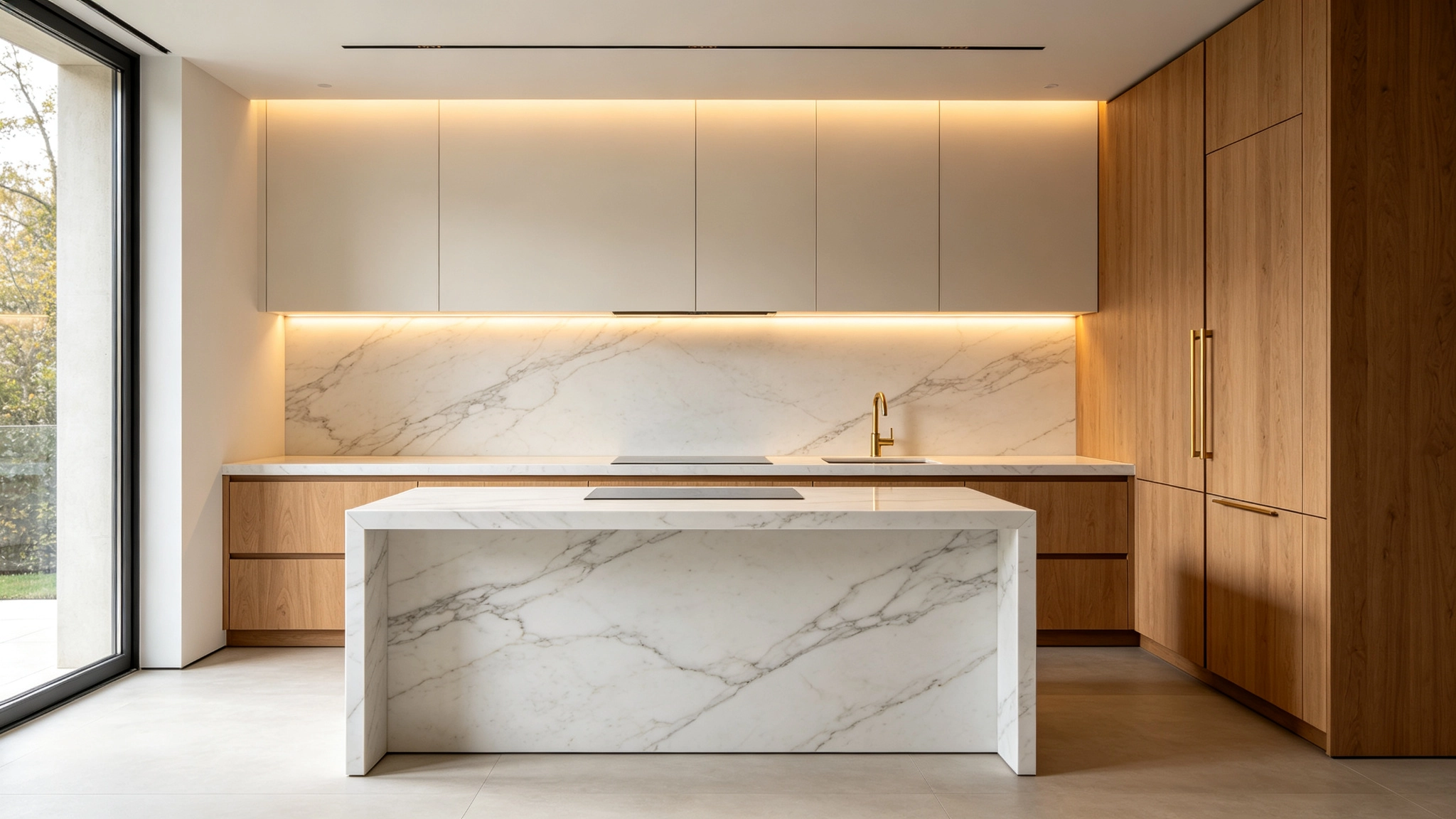
The growing combination of CNC bridge saws and waterjet machines is not a trend based solely on automation. It reflects a practical change in how stone fabrication is being organized.
A CNC bridge saw remains one of the most efficient solutions for high-volume straight cutting, mitre cutting, and primary slab processing. A CNC waterjet adds the flexibility required for complex contours, internal cutouts, decorative patterns, and geometries that are difficult to produce efficiently with a blade.
When these technologies are connected through CAD/CAM programming and optimized slab nesting, a stone factory can build a more complete digital fabrication workflow.
The result is a production system designed around cutting speed, geometric flexibility, material utilization, repeatability, and reduced dependence on manual correction.
For stone manufacturers expanding their countertop, architectural, porcelain, marble, granite, and custom fabrication capabilities, the question is no longer simply whether to buy a bridge saw or a waterjet.
Về Midecnc
Midecnc develops CNC stone processing solutions for manufacturers looking to improve cutting accuracy, production efficiency, and digital workflow integration. From CNC bridge saws and 5-axis bridge cutting systems to CNC waterjet machines, the right equipment configuration depends on the factory material mix, production volume, cutting geometry, and future capacity requirements.
Core Capabilities
High-Speed Straight Cutting
Leverage the CNC bridge saw for fast, precise straight cuts and rectangular separation
Complex Profile Handling
Waterjet technology handles internal cutouts, curves, and complex geometry without manual adjustment
Production Efficiency
Assign each job to the most suitable technology, eliminating bottlenecks and unnecessary operations
Material Savings
Maximize slab utilization and reduce waste through digital nesting and smart layout
Ready to Optimize Your Stone Fabrication Workflow?
Our expert team can help you evaluate whether a bridge saw, waterjet, or combined system fits your production needs.
Liên hệ
Phone
+86 155 9497 7687
sally@midecnc.com
+86 15594977687